
 USS Shaw explodes during the attack on Pearl Harbor, Dec. 7, 1941 (National Archives)
By George Morris
The day that helped define the 20th century started as a typical Sunday morning in 14-year-old Janice Hobson’s home in Honolulu, Hawaii. An Ink Spots song, “I Don’t Want to Set the World on Fire,” was playing on the radio. The only oddity was that her dad, usually the first one up, was sleeping late. It was almost 8 a.m.
But it wasn’t a normal Sunday. Someone was setting the world on fire.
Janice heard a car horn blowing across the street. From a window, she saw a neighbor, Edward Bogan — who, like her dad, Sebaldus, served in the Navy — running with his young daughter in his arms.
“He jumped out of the car, grabbed the little girl and went up these steps to our house screaming, ‘The g-d Japs are bombing the hell out of Pearl Harbor!’” she said.
It was Dec. 7, 1941, and Baton Rouge resident Janice Hobson Wall Monro remembers it well.
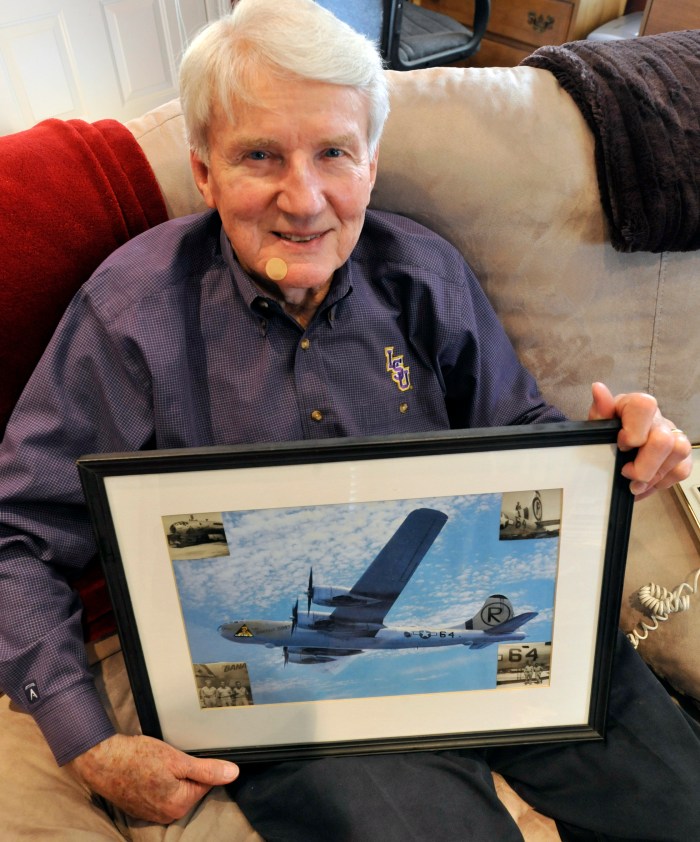 Paul Dietzel holds a photo of ‘Banana Boat,” the B-29 he piloted in bombing missions over Japan in World War II. (Photo by Bill Feig, used by permission of The Advocate, Baton Rouge, Louisiana)
 This flag, on display in the National Museum of the Pacific War in Fredericksburg, Texas, was made by prisoners of war held by the Japanese and is similar to one made by POWs held in Davao, Philippines, and Toyama, Japan, during World War II. (Photo by George Morris)
 The USS Kidd is now a war memorial and naval museum in Baton Rouge, Louisiana.
 WW2: The Big One