Meeting Rene Gagnon

A date with history *** Woman remembers meeting Marine... 09/30/04
Alyne Gray was the escort for Marine Pfc. Rene Gagnon at a May, 30, 1945 war bond rally in Alexandria, Louisiana. Gagnon was one of the six men who raised the second flag atop Iwo Jima’s Mount Suribachi, whose image became one of the most famous of World War II. (Photograph by Advocate staff photo by Patrick Dennis published on Oct. 22, 2004. Used by permission of The Advocate.)

By George Morris

Recently, the U.S. Marine Corps acknowledged it is investigating one of the most iconic images of World War II — Associated Press photographer Joe Rosenthal’s image of six men raising an American flag atop Iwo Jima’s Mount Suribachi. For 71 years, that group has been thought to include Navy Corpsman John Bradley. Now, historians are calling that into question.

No one, however, questions the presence of Marine Pfc. Rene Gagnon. After that image hit the front page of just about every American newspaper, Gagnon, Pfc. Ira Hayes and Bradley were pulled out of the war zone and taken stateside as celebrity spokesmen for war bond drives. The other three Marines — Cpl. Harlon Block, Sgt. Michael Strank and Pfc. Franklin Sousley — were killed in action on Iwo Jima.

A central Louisiana 19-year-old during World War II, Alyne Swayze Gray, had seen the photo. And, on May 30, 1945, she got to meet Gagnon.
Continue reading “Meeting Rene Gagnon”

Update: WASPs can be buried at Arlington

One of my recent posts was about Marion Brown’s service as a Women’s Airforce Service Pilot. Now, Congress has approved them for burial at Arlington National Cemetery. Overdue, but a good thing.

http://www.npr.org/sections/thetwo-way/2016/05/11/477716378/congress-approves-arlington-cemetery-burials-for-female-wwii-pilots?utm_source=twitter.com&utm_campaign=npr&utm_medium=social&utm_term=nprnews

Escape from Bilibid Prison

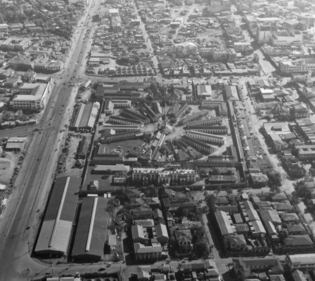
bilibid prison                                                                                      Bilibid Prison, a POW camp during World War II
By George Morris

Nobody could say Pfc. James Carrington wasn’t resourceful.

A Marine who was one of those captured when the Philippine island of Corregidor surrendered on May 9, 1942, he soon realized that survival would require his wits. At one point in his prison odyssey, he took two cans of spoiled milk, poured it into his shirt, squeezed it and left it to dry in the sun and make cheese.

On April 14, 1944, he would do something else remarkable. He would escape from Manila’s notorious Bilibid Prison — not only escape, but become a thorn in the enemy’s side.

Continue reading “Escape from Bilibid Prison”

Mass suicide by German civilians

This is a horrific account of eastern German civilians, either in fear of or response to the Soviet conquest of their towns, killing themselves and their children. Given how Soviet soldiers treated the Germans, it is understandable, but no less terrible. H/T to Dirk de Klein.

https://dirkdeklein.wordpress.com/2016/05/01/demmin-mass-suicide-1-may-1945/


Fall of Corregidor

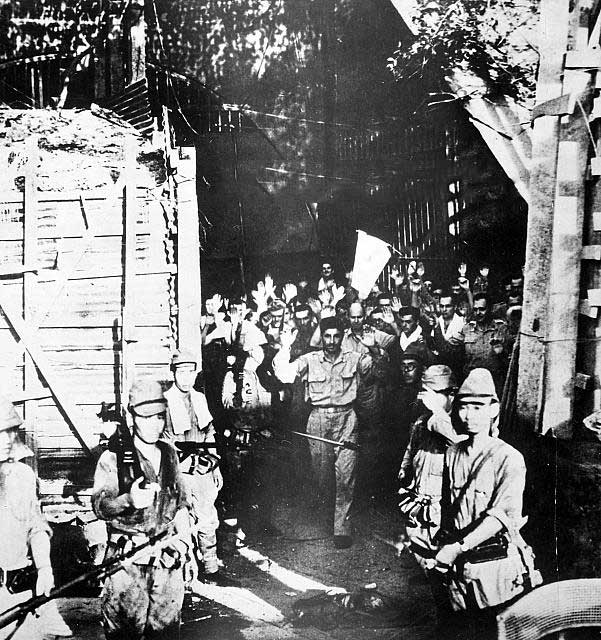
corregidor-surrender-to-japanese                    U.S. forces in the Malinta Tunnel surrender on Corregidor.

By George Morris

Once Japan invaded the Philippines shortly after the attack on Pearl Harbor, American military leaders quickly realized the islands were a lost cause. But, if U.S. and Philippine forces couldn’t defeat the enemy, it could accomplish something else — delay them.

Delay had its last major stand at Corregidor.

A hunk of rock 2.5 miles long and a half-mile wide. It would have been a worthless piece of real estate had it not been situated at the mouth of Manila Bay. About 12,000 soldiers and Marines were ordered to hold it at all costs.

Continue reading “Fall of Corregidor”

The Katyn Massacre

Katyn_massacre_1Mass grave discovered in 1943 in Katyn, USSR.


By George Morris

Dachau. Bataan. Katyn. Generations of post-war Americans have grown up knowing about the first two places, but few have heard of the third.

But Sophia Grebocki Denham was aware. She lost her husband there.

“People should know what happened there,” Denham said in 2000.

What happened there was an atrocity.

Continue reading “The Katyn Massacre”

WASPs left their mark on World War II

Women_Airforce_Service_PilotsFrances Green, Margaret “Peg” Kirchner, Ann Waldner and Blanche Osborn during WASP ferry training on the B-17 Flying Fortress (U.S. Air Force photo)

By George Morris

There was a lot the U.S. Army Air Forces couldn’t have imagined on Dec. 6, 1941. One was Marion Brown.

After the next day, eyes and minds started opening rather quickly.

There was no doubt that, for the first time in history, a major war would involve a significant contribution by air forces. It was planes, not ships, that attacked Pearl Harbor, and it was German fighter planes, dive bombers and heavy bombers that blitzed through Europe and pounded England. It took little imagination to envision that airmen would have an enormous role.

But women? They would have a part to play, too, even if not in combat.

Continue reading “WASPs left their mark on World War II”

The long, awful march from Stalag Luft IV

stalag luft IV evac                                                                                POWs being evacuated from Stalag Luft IV, early 1945 (Source: http://www.dvrbs.com/camden-heroes/CamdenHeroes-FrankGramenzi.htm)

By George Morris

The sound of an approaching army — especially a mechanized one — is impossible to miss, particularly when it is engaged with its enemy. In January 1945, Allied prisoners of Stalag Luft IV heard the Soviet army driving westward through Poland.

“We could hear the gunfire, the cannons,” said Russell McRae, a Baton Rouge resident. “We could see the flashes at night. We knew we were going to get overrun, and we thought we’d be liberated.”

They would — some of them, anyway. But not for a long time, and not by the Soviets.

Continue reading “The long, awful march from Stalag Luft IV”

USS Hornet: Launching the Doolittle Raid

doolittle-hornetA B-25 launches from the USS Hornet on April 18, 1942, as part of the Doolittle Raid on Japan.

By George Morris

Less than two months after Japan’s Dec. 7, 1941 attack on Pearl Harbor launched the United States into World War II, the USS Hornet sailed from its base at Norfolk, Virginia with two B-25 bombers aboard. That had the sailors talking.

“We had scuttlebutt running around, all kinds of scuttlebutt,” said Tom Varnado, who served aboard the Hornet. “We just thought that was an experiment to see if they could take off.”

Which they did. Two months later, when the Hornet departed San Francisco Bay, there were 16 B-25s aboard, but the sailors thought they would simply be delivering the aircraft to Pearl Harbor. After all, the Hornet passed under the Golden Gate Bridge in broad daylight with the bombers in plain sight on the flight deck.

“Traffic was just stopped there,” Varnado said. “It was just a mass of people on the bridge. We went right under them. I thought, ‘Well, we’re not going on a secret mission because they wouldn’t do this.'”

But they would. A day into the cruise, the crew got the news. They weren’t going to Pearl Harbor. They were going to bomb Japan.

Continue reading “USS Hornet: Launching the Doolittle Raid”

Kamikaze Hits the USS KIDD

Kidd at sunsetThe USS Kidd is now a war memorial and naval museum in Baton Rouge, Louisiana.

By George Morris

On April 11, 1945, Maurice Clements was in charge of one of a Fletcher-class destroyer’s largest guns as it cruised the waters 90 miles east of Okinawa. Yet, when a lone Japanese plane came in low and headed for the ship’s starboard side, there was nothing he could do.

So, he had a front row seat for a sailor’s worst nightmare late in World War II — a successful kamikaze attack.

In this case, it was the USS Kidd. The attack killed 38 and wounded 55 of the destroyer’s 320 sailors. As fate would have it, the Kidd would eventually be turned into a naval museum on the Mississippi River in Clement’s home town, Baton Rouge, Louisiana. He attends memorial services held there, including one held on the 70th anniversary of the attack in 2015.

“They were all my friends,” he said.

Continue reading “Kamikaze Hits the USS KIDD”