The clock ticks down to D-Day

D-Day, ready to board ships at Weymouth
Soldiers march toward the ships they’ll board for the Normandy Invasion. (National Archives)

By George Morris

They all knew it was coming. It was the reason they were in Great Britain, training for the great invasion of Western Europe. On April 6, all leave had been cancelled for the invasion troops. It was getting closer. But when would it be?

Nobody knew. Even as the towns, woods and roads of southern England filled with more and more men and machines, many of the troops had no inkling of how close the invasion was.

“We were one unit in that town, and we were not allowed to go just any place we wanted to,” said Mike Simpson, a medic with the 4th Infantry Division. “So, we didn’t know the magnitude of what was going on.”

Continue reading “The clock ticks down to D-Day”

Restoring PT-305 brings three generations together

PtBoatbuilders.adv043.jpg
Clifford Grout, left, and his father John Grout with keepsakes from Clifford’s grandfather, who worked at Higgins Industries in New Orleans. Now, Clifford, his son and his father volunteer to help restore a PT boat that will be displayed at the National WWII Museum in New Orleans. (Photo by Richard Alan Hannon, used by permission of The Advocate)

By George Morris

Baton Rouge architect Clifford Grout never met his grandfather, who died in a 1957 car accident, 18 months before Clifford’s birth. But almost every weekend at the National World War II Museum in New Orleans, grandson has grown closer to grandfather.

One tube of caulk, one paint brush stroke, one hammer swing at a time.

And he’s not alone. On any given Saturday, three generations of Grouts pay tribute to their forebear by helping restore one of the wartime vessels his work helped create.

Continue reading “Restoring PT-305 brings three generations together”

Returning part of a soldier’s history

Zachary Trussell, Elena Branzaru
Zachary Trussell holds the dog tag he found with his aunt, Elena Branzaru, along the Mississippi River in Baton Rouge. The dog tag now is back with its rightful owner. (Photo by Arthur D. Lauck, used by permission of The Advocate newspaper)

By George Morris

It’s not every day I get asked to help locate someone, not knowing whether or not he is even alive. But when it involves returning a lost dog tag to a soldier? I’m all in.

In 2007, Elena Branzaru and her nephew, Zachary Trussell, were spending Memorial Day in downtown Baton Rouge, Louisiana, when they wandered to the edge of the Mississippi River.

“We were just messing around because we were on the levee,” Branzaru said. “We didn’t know what we were going to find.”

Lying amid broken glass, weeds, litter and driftwood near the Interstate 10 bridge was a dog tag that had been issued to Clarence A. Burke when he enlisted shortly after Japan’s Dec. 7, 1941, attack on Pearl Harbor. Burke, we would discover, hadn’t lived in Baton Rouge in more than a half-century.

Continue reading “Returning part of a soldier’s history”

Escape from Bilibid Prison

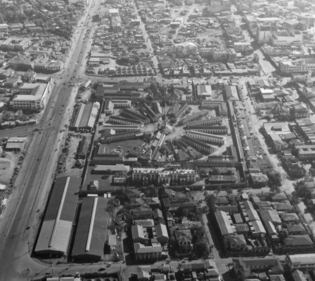
bilibid prison                                                                                      Bilibid Prison, a POW camp during World War II

By George Morris

Nobody could say Pfc. James Carrington wasn’t resourceful.

A Marine who was one of those captured when the Philippine island of Corregidor surrendered on May 9, 1942, he soon realized that survival would require his wits. At one point in his prison odyssey, he took two cans of spoiled milk, poured it into his shirt, squeezed it and left it to dry in the sun and make cheese.

On April 14, 1944, he would do something else remarkable. He would escape from Manila’s notorious Bilibid Prison — not only escape, but become a thorn in the enemy’s side.

Continue reading “Escape from Bilibid Prison”

WASPs left their mark on World War II

Women_Airforce_Service_PilotsFrances Green, Margaret “Peg” Kirchner, Ann Waldner and Blanche Osborn during WASP ferry training on the B-17 Flying Fortress (U.S. Air Force photo)

By George Morris

There was a lot the U.S. Army Air Forces couldn’t have imagined on Dec. 6, 1941. One was Marion Brown.

After the next day, eyes and minds started opening rather quickly.

There was no doubt that, for the first time in history, a major war would involve a significant contribution by air forces. It was planes, not ships, that attacked Pearl Harbor, and it was German fighter planes, dive bombers and heavy bombers that blitzed through Europe and pounded England. It took little imagination to envision that airmen would have an enormous role.

But women? They would have a part to play, too, even if not in combat.

Continue reading “WASPs left their mark on World War II”

The long, awful march from Stalag Luft IV

stalag luft IV evac                                                                                POWs being evacuated from Stalag Luft IV, early 1945 (Source: http://www.dvrbs.com/camden-heroes/CamdenHeroes-FrankGramenzi.htm)

By George Morris

The sound of an approaching army — especially a mechanized one — is impossible to miss, particularly when it is engaged with its enemy. In January 1945, Allied prisoners of Stalag Luft IV heard the Soviet army driving westward through Poland.

“We could hear the gunfire, the cannons,” said Russell McRae, a Baton Rouge resident. “We could see the flashes at night. We knew we were going to get overrun, and we thought we’d be liberated.”

They would — some of them, anyway. But not for a long time, and not by the Soviets.

Continue reading “The long, awful march from Stalag Luft IV”

Kamikaze Hits the USS KIDD

Kidd at sunsetThe USS Kidd is now a war memorial and naval museum in Baton Rouge, Louisiana.
By George Morris

On April 11, 1945, Maurice Clements was in charge of one of a Fletcher-class destroyer’s largest guns as it cruised the waters 90 miles east of Okinawa. Yet, when a lone Japanese plane came in low and headed for the ship’s starboard side, there was nothing he could do.

So, he had a front row seat for a sailor’s worst nightmare late in World War II — a successful kamikaze attack.

In this case, it was the USS Kidd. The attack killed 38 and wounded 55 of the destroyer’s 320 sailors. As fate would have it, the Kidd would eventually be turned into a naval museum on the Mississippi River in Clement’s home town, Baton Rouge, Louisiana. He attends memorial services held there, including one held on the 70th anniversary of the attack in 2015.

“They were all my friends,” he said.

Continue reading “Kamikaze Hits the USS KIDD”

Bataan Death March

Bataan Death March
Prisoners of war on the Bataan Death March. (U.S. Air Force photo)

By George Morris

When their ship passed under the Golden Gate Bridge on Nov. 1, 1941, all J.S. Gray and his buddy, Cletis Overton, knew was they were heading to Manila, Philippines. As they left Hawaii, though, ships carrying their airplanes left the convoy. Gray, an ordnance specialist, and Overton, an airplane mechanic with the Army Air Forces, received no explanation. They learned after the war that the planes went to Australia.

“We were looking out watching them, and they just turned south, and we never saw them again,” Gray said.

They would soon see airplanes, but they weren’t American.

Continue reading “Bataan Death March”

Missing in Action

RemiDelouche052.jpg
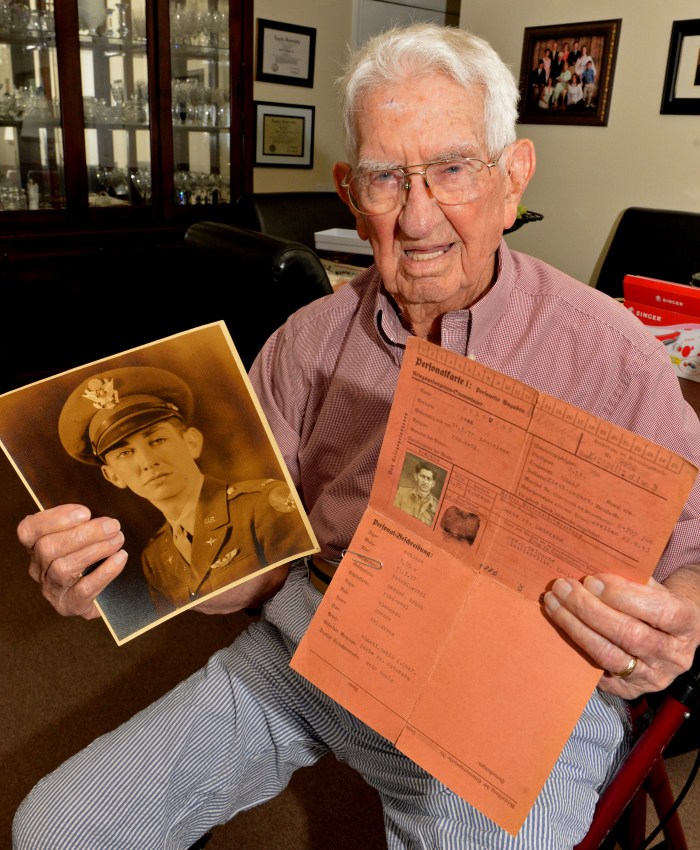
Remi DeLouche (Photo by Patrick Dennis, published Nov. 10, 2013, used by permission of The Advocate.)

By George Morris

Considering that Remi DeLouche was captured not once, but twice — and by the armies of two different nations, no less — he thought somebody would have told his family of his circumstances.

It was only when he was reunited with them that he found out otherwise.

“When I got home, my mother and my dad came out and man, they were crying. It was like I was dead,” DeLouche said. “They said, ‘You’ve been missing.’ Apparently no one noticed that I’d been captured.”

Continue reading “Missing in Action”

Building Patton’s bridges

Charles Hair... 04/11/02
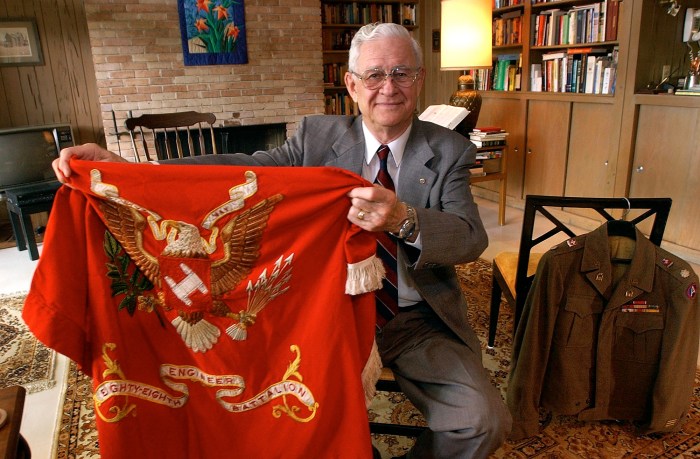
Charles Hair (Photo by Travis Sprawling, published April 24, 2002, used by permission of The Advocate.)

By George Morris

In almost a quarter-century as city engineer in Baton Rouge, Louisiana, Charles Hair Jr. was responsible for a lot of bridges. But no one was shooting at him when they were being built.

Hair wasn’t always so fortunate as commander of the 3rd Army’s 88th Engineer Heavy Ponton Battalion. His outfit made 15 river crossings as Gen. George S. Patton Jr. led 3rd Army through France, Luxembourg and on into Germany.

The 88th made three crossings of the Seine, five of the Moselle (in three countries) and three of the Main. They never had to make the same crossing twice.

“To be a good soldier, you’ve got to be lucky,” Hair said in 2002. “We went through that whole thing without any severe times, because when Patton crossed a river, he stayed. If he’d gotten thrown back, we would have been lost.”

Continue reading “Building Patton’s bridges”