Before his football fame, World War II shaped Paul Dietzel

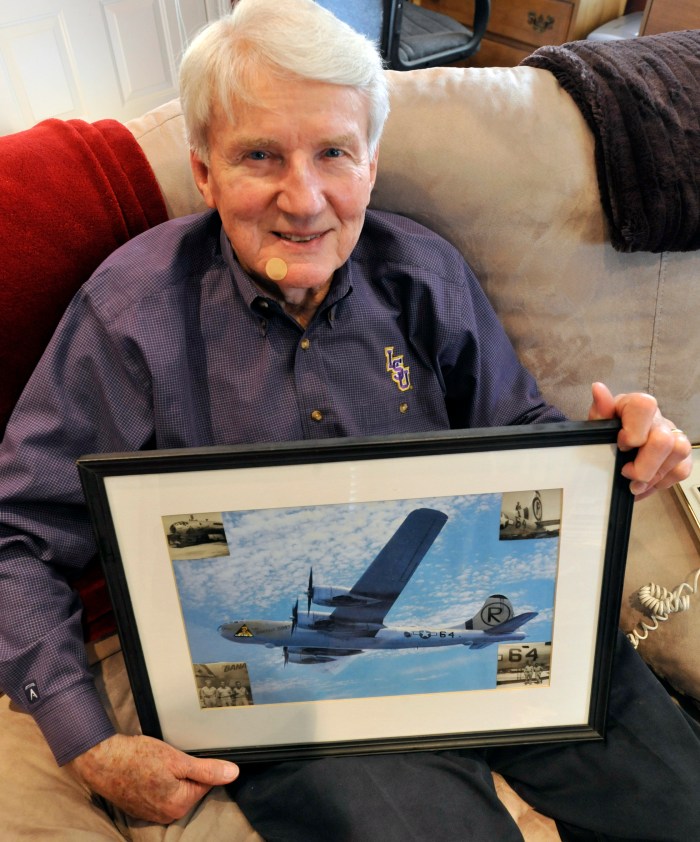
dietzel211.adv.jpgPaul Dietzel holds a photo of ‘Banana Boat,” the B-29 he piloted in bombing missions over Japan in World War II. (Photo by Bill Feig, used by permission of The Advocate, Baton Rouge, Louisiana)

By George Morris

Much of the memorabilia that Paul Dietzel kept at his Baton Rouge home involved a legendary sports career — All-America football player, national championship at LSU, connections to such coaching legends as Paul Brown, Bear Bryant, Earl Blaik and Sid Gillman.

Among the plaques, posters and game balls, however, was a photo of the B-29 bomber he flew over Japan in World War II, years before the lesser combat of football made him famous.

There is no question, Dietzel said, as to which experience was the more important.

“Those two and a half, three years, that was the greatest part of my life,” Dietzel said. “I owe it so much.”

Continue reading “Before his football fame, World War II shaped Paul Dietzel”

The first U.S. soldier to die in Europe

Loustalot_GraveKilled in the disastrous raid on Dieppe, France, Edward Loustalot was the first American solder to die in Europe in World War II.
By George Morris

The cross at Edward V. Loustalot’s grave is all but identical to the tens of thousands of markers that spread across American military cemeteries in Europe. Like the others, row on row, it communicates with classic military brevity: name, rank, unit, place of birth, date of death.

Only that last piece of information tells of his historical significance.

When he died, the United States had fought in World War II for less than nine months. Already, American military personnel had been killed in the Pacific, just the first of multitudes who would die there, in Asia, in Africa and, ultimately, in Europe.

For the foot soldiers, Europe’s toll came last, the carnage delayed until invasions of Italy in 1943 and Normandy in 1944. But, little remembered amidst the more epic battles of the war, a small band of Americans was part of a force that landed at the French coastal resort of Dieppe on Aug. 19, 1942.

On that day, Loustalot, a Franklin, Louisiana native, became the first American soldier to die on European soil in World War II.

Continue reading “The first U.S. soldier to die in Europe”

Working on planes that ended the war

Fat Man, Little Boy and the Graci brothers *** New Orleans natives got a close look at the atomic bombs that ended WWII

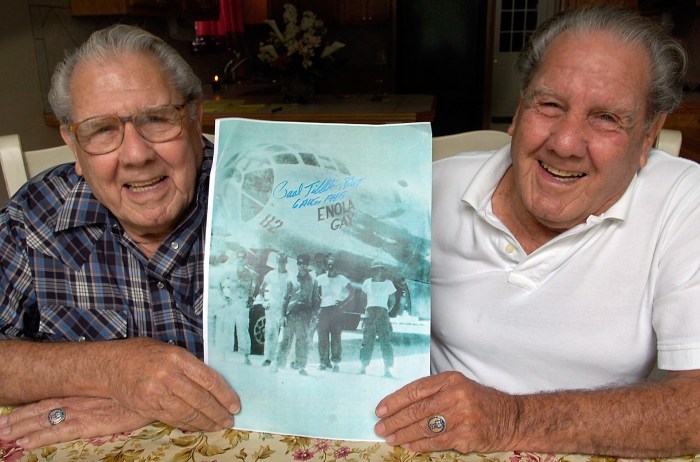
Twins  Ben and Joe Graci, originally of New Orleans, hold a photo they are in that was autographed by pilot Paul Tibbets. They served on the Pacific island of Tinian, from which the airplanes took off that dropped both atomic bombs of Japan. (Photo by Bill Feig, used by permission of The Advocate, Baton Rouge, Louisiana)

By George Morris

In the months that twin brothers Joe and Ben Graci of New Orleans worked on the Pacific island of Tinian, Col. Paul Tibbets was just another pilot they knew and the “Enola Gay” was just another bomber that they and their comrades worked to keep flying in World War II.

That changed abruptly on Aug. 6, 1945.

When the B-29 Superfortress bomber flown by Tibbets dropped an atomic bomb code named “Little Boy” on Hiroshima, Japan, it was just as big a surprise to the men on Tinian as it was to the rest of the world. They found out about it the next day.

“Everybody went wild,” Joe Graci said.

Continue reading “Working on planes that ended the war”

On the run behind German lines

Osce Jones                                   P-51 pilot Osce R. Jones poses beside his aircraft. (Photo provided by Carol Ann Jones Lizana)

By George Morris

Many veterans returned from World War II with stories to tell, and most relied only on their memory.

P-51 fighter pilot Osce R. Jones, had something more tangible — a diary.

Forced down over occupied France by antiaircraft fire the day after the D-Day invasion, Jones, of Baton Rouge, Louisiana, spent a week trying to evade capture and work his way back to England. He got caught, but while the events were fresh on his mind in a POW camp, he wrote about his experiences in a tiny notebook. His wife, Thelma, kept the notebook after he died in 1994.

“He had to write real small, because they didn’t have much paper,” she said.

The small print told a big story.

Continue reading “On the run behind German lines”

‘Who more than self their country loved’

peo LeonStandifer bf 040.jpg
Leon Standifer holds the French Legion of Honor media he was awarded on April 26, 2012, in New Orleans (Photo by Bill Feig, used by permission of The Advocate, Baton Rouge, Louisiana)

By George Morris

The headstones are there by the thousands, row on row. Throughout Western Europe, American dead from two world wars are at rest, many near the epic battlefields where they lost their lives.

Fifty years after he lost his dear wartime comrade, Leon Standifer didn’t go to any of those. Rather, he showed up in a tiny town in a corner of France where little real action took place. But even there, men of courage stood up.

And, in the case of Dale Proctor, fell. Standifer couldn’t let that be forgotten.

So, far from the grand ceremonies that marked other half-century remembrances, Standifer came to a country road outside Redene, a small Brittany town, where about 60 persons gathered to celebrate their liberation from Nazi Germany. Most who attended had lived through the occupation. Few, however, knew the man they specifically honored that day.

Standifer did.

Continue reading “‘Who more than self their country loved’”

A “Lucky Bastard”

Rex Shearer... 10/11/04
Rex Shearer, from Baton Rouge, was an engineer/top turret gunner on a B-17 crew during WWII and was awarded a “Lucky Bastards Club” certificate after surviving the required missions and being sent home. (Photo by Patrick Dennis, used by permission of The Advocate, Baton Rouge, Louisiana)

By George Morris

Call a man a “lucky bastard” and you’re asking for a punch in the nose. But not from Rex Shearer.

When the B-17 named “Blythe Spirit” touched down at Rattlesden, England, in early February 1945, Shearer and the rest of the nine-man crew joined the elite ranks of those who completed all their bombing missions over Europe.

They called it the “Lucky Bastards Club.” The name was appropriate.

“We were fortunate,” said Shearer, a Kansas native and Baton Rouge resident since 1965.

Continue reading “A “Lucky Bastard””

Rocket man

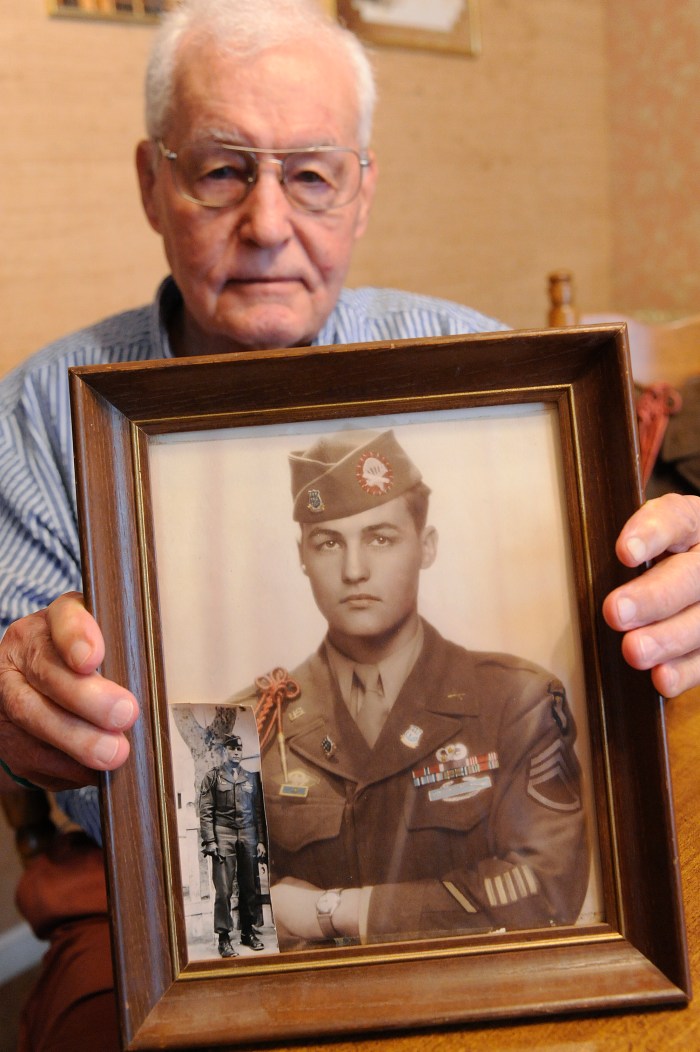
Me_163BA German Messerschmitt Me 163B Komet rocket-propelled fighter at the National Museum of the United States Air Force, Dayton, Ohio (Public domain photo)

By George Morris

In 1943, a month before his 16th birthday, Joachim “Joe” Hoehne was drafted into the German military. It was the fate of many boys his age in a country seeing World War II’s fortunes turning against it.

Unlike most of his contemporaries, though, Hoehne ended up on the cutting edge of aviation.

Hoehne, later a resident of Denham Springs, Louisiana, flew the Messerschmitt 163 Komet, a rocket plane introduced late in the war as the United States, Britain, Russia and France tightened the noose on Germany. Although it had little impact on the war’s outcome, it indicated where manned flight was heading.

Two years after the war, Chuck Yeager flew faster than the speed of sound in an X-1 rocket plane. Today, the vehicle’s most advanced descendent is the space shuttle.

All of that, of course, was more than Hoehne could have imagined at the time, even though he had grown up around aviation.

Continue reading “Rocket man”

17 days on a lifeboat in the Atlantic

Bob Talley... 12/16/98
Baton Rouge resident Bob Talley spent 17 days adrift on a life raft with several dozen other soldiers during WWII, and lived to tell the tale. (Photo by Mark Schiefelbein, used by permission of The Advocate, Baton Rouge, Louisiana)

By George Morris

Shortly after America’s entry into World War II, when German submarines were sinking American merchant vessels at a frightening rate in the Atlantic Ocean, Bob Talley was far from that action — and, he thought, about to get farther.

A U.S. Navy gunner, Talley was aboard a troop ship about to sail from San Francisco to Australia. But, an hour before it lifted anchor, Talley was ordered ashore. He stood on the pier and watched the ship leave.

“We were in San Francisco having a time,” Talley said. “We felt sorry for those fellows on the East Coast. Those subs were knocking them off one a week over there.

“All of a sudden, we woke up one morning and got orders to report to New York City.”

Those orders led Talley directly into the U-boat war in the Atlantic and to an ordeal that all mariners dread.

Continue reading “17 days on a lifeboat in the Atlantic”

Turning down a million-dollar wound

JamesCombs.adv
World War II Veteran James Combs shows off a photo of himself at age 24 Thursday at his home in Lafayette, Louisiana. (Photo by Bryan Tuck, used by permission of The Advocate, Baton Rouge)

By George Morris

For many soldiers in World War II, the best thing that could happen in combat was the “million-dollar wound” — one that didn’t maim for life, but sent them home.

Monroe Combs got his million-dollar wound shortly after D-Day, when artillery shrapnel struck one of his lungs. He was sent to a tent hospital on the Normandy coast.

“This captain said, ‘You got a chest penetration, so you’re home-bound,’” Combs said. “I said, ‘Really? I’m not going home. … I’m going to make that next jump.’ As I recall, I really took him back.”

By not cashing in, Combs would become part of one of the war’s most famous outfits.

Continue reading “Turning down a million-dollar wound”

A story for Flag Day

POW flagThis flag, on display in the National Museum of the Pacific War  in Fredericksburg, Texas, was made by prisoners of war held by the Japanese and is similar to one made by POWs held in Davao, Philippines, and Toyama, Japan, during World War II. (Photo by George Morris)

By George Morris

When people think of World War II, the famous flag-raising at Iwo Jima is one of the most memorable images. But there is another flag from that conflict, and a friend of mine, that you should know about.

Continue reading “A story for Flag Day”