This is a place to reflect on history's greatest conflict. You'll see stories about soldiers, sailors, Marines, airmen and civilians, people I've been privileged to meet as a reporter for Louisiana's largest daily newspaper, The Advocate. You're welcome to share stories of your own by posting a comment or emailing the author at mc2010morris@gmail.com.
This is a horrific account of eastern German civilians, either in fear of or response to the Soviet conquest of their towns, killing themselves and their children. Given how Soviet soldiers treated the Germans, it is understandable, but no less terrible. H/T to Dirk de Klein.
POWs being evacuated from Stalag Luft IV, early 1945 (Source: http://www.dvrbs.com/camden-heroes/CamdenHeroes-FrankGramenzi.htm)
By George Morris
The sound of an approaching army — especially a mechanized one — is impossible to miss, particularly when it is engaged with its enemy. In January 1945, Allied prisoners of Stalag Luft IV heard the Soviet army driving westward through Poland.
“We could hear the gunfire, the cannons,” said Russell McRae, a Baton Rouge resident. “We could see the flashes at night. We knew we were going to get overrun, and we thought we’d be liberated.”
They would — some of them, anyway. But not for a long time, and not by the Soviets.
Remi DeLouche (Photo by Patrick Dennis, published Nov. 10, 2013, used by permission of The Advocate.)
By George Morris
Considering that Remi DeLouche was captured not once, but twice — and by the armies of two different nations, no less — he thought somebody would have told his family of his circumstances.
It was only when he was reunited with them that he found out otherwise.
“When I got home, my mother and my dad came out and man, they were crying. It was like I was dead,” DeLouche said. “They said, ‘You’ve been missing.’ Apparently no one noticed that I’d been captured.”
One point that all World War II military leaders whose armed forces included airborne troops were in agreement about: the dashing young men who made up their parachute regiments were not only brave…
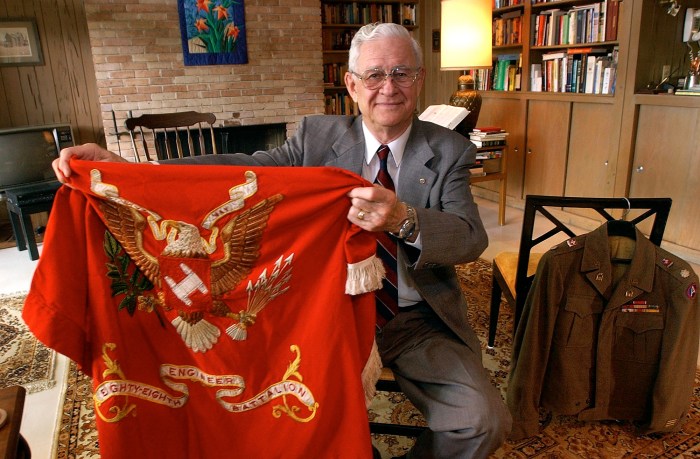
Charles Hair (Photo by Travis Sprawling, published April 24, 2002, used by permission of The Advocate.)
By George Morris
In almost a quarter-century as city engineer in Baton Rouge, Louisiana, Charles Hair Jr. was responsible for a lot of bridges. But no one was shooting at him when they were being built.
Hair wasn’t always so fortunate as commander of the 3rd Army’s 88th Engineer Heavy Ponton Battalion. His outfit made 15 river crossings as Gen. George S. Patton Jr. led 3rd Army through France, Luxembourg and on into Germany.
The 88th made three crossings of the Seine, five of the Moselle (in three countries) and three of the Main. They never had to make the same crossing twice.
“To be a good soldier, you’ve got to be lucky,” Hair said in 2002. “We went through that whole thing without any severe times, because when Patton crossed a river, he stayed. If he’d gotten thrown back, we would have been lost.”
You never expect anyone outside the skinhead community to say anything good about Adolf Hitler, and certainly not at an Army reunion. But in a conference room of a New Orleans hotel in 1992, I asked Don Malarkey to explain the camaraderie he shared with the men he fought beside.
He stopped, rubbed his eyes and apologized for the emotion before he attempted an answer.
“I thank Adolf Hitler for every day that I had with these people,” Malarkey said. “We’re closer than family.”

 Mass grave discovered in 1943 in Katyn, USSR.
 POWs being evacuated from Stalag Luft IV, early 1945 (Source: http://www.dvrbs.com/camden-heroes/CamdenHeroes-FrankGramenzi.htm)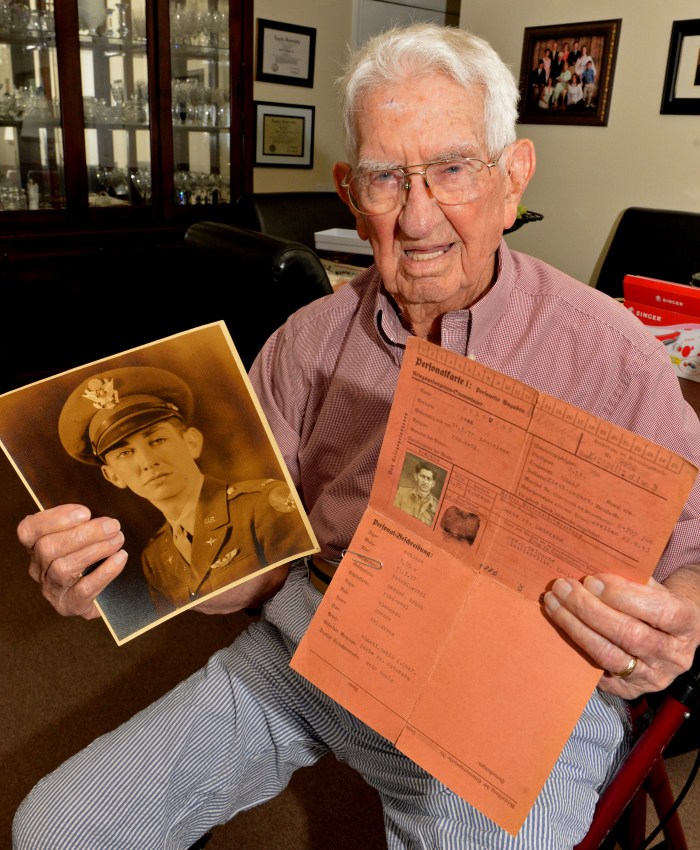
 WW2: The Big One